January PrepCom
March 2, 2026
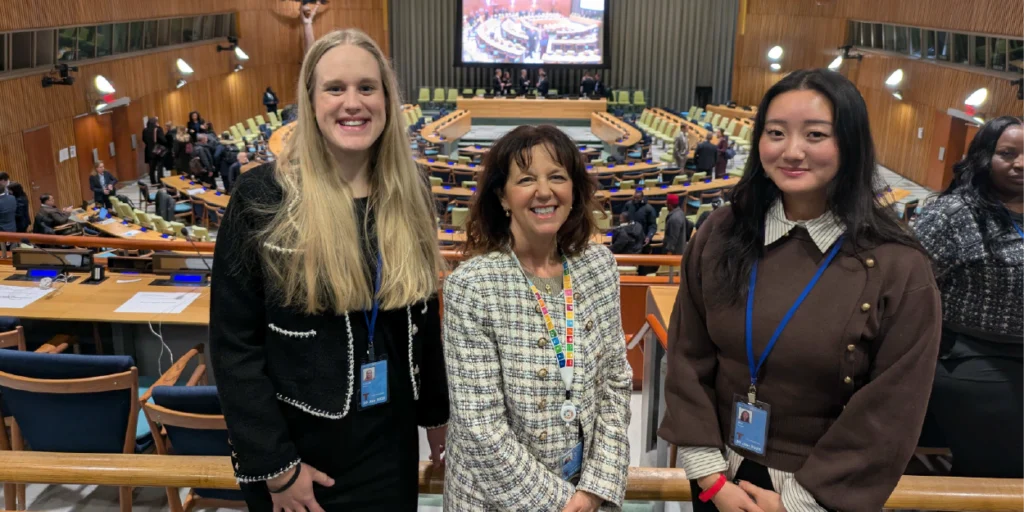
This past January, Susan and I traveled to New York to attend the first three days of the Preparatory Committee (PrepCom) for the proposed treaty on the prevention and punishment of crimes against humanity. Our attendance was made possible through funding from the Whitney R. Harris World Law Institute, allowing us to witness a significant milestone in the development of international criminal law.
The session began with opening plenary statements from Member States, who outlined their general positions and support for the 2019 Draft Articles. However, the transition into substantive discussion was delayed by an extended debate regarding the election of the Bureau.
While Ireland was the designated chair, Russia proposed an expansion of the Bureau to include more states, citing a need for better regional representation. This procedural disagreement, which was likely rooted in the planned inclusion of Ukraine in the Bureau, delayed the start of the scheduled debates for the first cluster of articles. The Trusteeship Council was filled with both an air of excitement watching the debate play out, but also a general desire among the delegations and CSOs to resolve the impasse and begin the technical work.
The Committee’s work is organized into five “clusters” for discussion. During our time at the UN, we followed the debate on Cluster 1, which covers the preamble to the treaty and article 1. Article 1 covers the definition of Crimes Against Humanity, which was a particularly hot topic throughout the PrepCom.
During the entirety of the PrepCom, we were particularly interested in how states addressed: (1) the definition of Crimes Against Humanity and whether the Rome Statute definition should be incorporated, (2) the definition, scope, and inclusion of the words “sex” and “gender” in the treaty, and (3) the level of participation that would be granted to non-governmental organizations (NGOs) and Civil Society Organizations (CSOs) as the process moves forward.
The inclusion of the Crimes Against Humanity definition from Article 7 of the Rome Statute is a central point of contention because some states view that definition as progressive legislation rather than codification of customary international law. For many states, particularly those already party to the International Criminal Court (ICC), the Rome Statute represents the “crystallization” of customary international law. They argue that maintaining identical language is essential for legal consistency. However, states that are not party to the Rome Statute view the Rome Statute as “progressive” instrument containing specific treaty-based obligations they never agreed to. For these non-party states, there is a palpable concern that adopting the Rome Statute’s definitions verbatim would effectively force them to accept the ICC’s jurisdictional framework and legal interpretations without ever formally joining the Court. This creates a difficult balancing act for the PrepCom: how to draft a treaty that is robust enough to be effective, yet flexible enough to achieve the universal buy-in that the Rome Statute currently lacks.
We also paid close attention to the debate over whether to include a formal definition of “gender.” A group of conservative states advocated for inserting restrictive language which limits the term to “the two sexes, male and female.” For these delegations, a traditional, biological definition is seen as a necessary safeguard for national sovereignty. Conversely, a coalition of more liberal states and the majority of CSOs in the gallery argued against including any definition at all. They contend that leaving the term undefined allows the treaty to remain “future-proof,” reflecting the contemporary understanding of gender as a social construct in line with evolving human rights standards.
Finally, we monitored debates regarding CSO participation because there was a real possibility that CSOs could be excluded from future negotiations. Some delegations argued for a strict state-led process to avoid political advocacy or procedural delays. Conversely, a broad coalition of states and observers argued that excluding civil society would undermine the treaty’s legitimacy, noting that CSOs provide essential, independent expertise and represent the “lived experience” of victims. The eventual decision to permit and even expand participation was a major victory for the crowded gallery.
In fact, one of the most notable aspects of the session was the high volume of civil society observers. All official seats designated for CSO members in the upper level were occupied, and much of the public gallery was full as well. Everyone seemed really engaged with the debates; it seemed as if no one could catch a break from their note taking and analyzing. This presence underscored the global importance of the treaty process. Ultimately, it was confirmed that CSO participation will be permitted during the later negotiation stages—a huge victory for everyone in the gallery.
Observing the opening of the PrepCom provided a clear look at the intersection of international law and high-level diplomacy. Seeing a project that was born right here at WashU Law reach the floor of the United Nations was a significant experience. We are grateful to the Harris World Law Institute for the funding that allowed us to witness this foundational step in the treaty-making process.
Erin Layne and Susan Wu