
Pursuing Justice in Post-Apartheid South Africa: WashU Law Student Xochi Hopwood’s Externship with the Legal Resource Centre
October 16, 2025
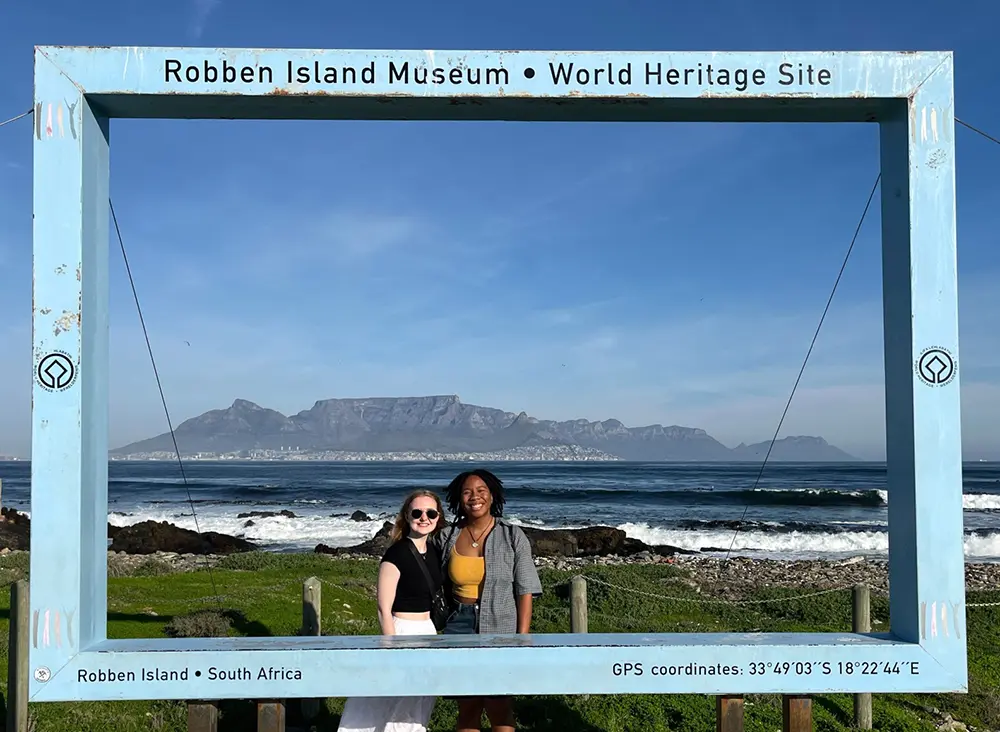
In May, Xochi Hopwood, a student at WashU Law, took part in the International Justice & Conflict Resolution Externship, interning with the Legal Resource Centre in South Africa. Xochi provides a description of her experience below:
After 27 years in prison, Nelson Mandela famously said, “No one is born hating another person because of the color of his skin, or his background, or his religion. People must learn to hate, and if they can learn to hate, they can be taught to love.” South Africa’s dark history of apartheid is well known, along with Nelson Mandela’s inspiring role in ending it. The main body that helped investigate apartheid’s human abuses was the Truth and Reconciliation Commission (“TRC”), and it proved to have powerful effects: it gave a voice to a silenced people who suffered gross human rights violations. In another radical attempt for reconciliation, the TRC allowed perpetrators to express regret and submit requests for amnesty. A little later, South Africa enshrined these principles of human dignity, equality, and freedom in its Constitution in 1996. It contained revolutionary provisions: it was the first to prohibit discrimination for sexual orientation, made socioeconomic security a fundamental right, and included environmental protection in its Bill of Rights.
I touched down in Cape Town in late May for an internship with the Legal Resource Centre (LRC), a non-profit public interest law centre with locations throughout South Africa. Started in 1979, the LRC formed with the goal to fight apartheid through legal means and to train young Black lawyers. Through my time there, the LRC’s hallways remained filled with clients desperate for help: a young woman with no legal proof of existence because she was never issued a birth certificate, a gay man attempting to qualify as a refugee in South Africa as it’s the only African nation with legalized same-sex marriage, or an indigenous family whose community members were shot dead for fishing in their native areas.
While South Africa is a leader in radical reconciliation and progressive ideals, it still bares the vestiges of systemized segregation. The beginning of 2025 marked a 32.9% unemployment rate, and for comparative purposes, the Great Depression’s height of unemployment was 24.9%. In 2024, South Africa had the worst income inequality in the world, where the year before it was estimated that the top ten percent had 85% of the nation’s total wealth. Further, a study in 2024 revealed that the typical Black household in South Africa owns 5 per cent of the wealth held by the typical White household. The list continues, making it a true honor that I was able to work with a team who harnesses the law’s power to fight these injustices.
Like many this past spring, I found myself reeling from the political chaos occurring in the United States. Just a few months prior to my arrival in Cape Town, President Trump had released an executive order granting refugee status to white Afrikaners. In light of South Africa’s glaring inequality and its undeniable tie to racism, this was hard to stomach. Perhaps what was even more troubling about my arrival in Cape Town was how often I was reminded of the features of American race relations—frequently ignored, persisting through the generations, and misrepresented so as to avoid responsibility. What was different, however, was South Africa’s palpable pursuit of reconciliation and equality, starting all the way back with the TRC. While their progress has been imperfect, the changes occurring since 1996 are nothing short of remarkable. During my time I experienced a shining piece of South Africa’s legacy, it is a nation that continues to teach the world that no matter what hate is being spread, no matter how dark the shadows of injustice become, we as citizens of the world, as Mr. Mandela said, have the ability to teach each other to love.
Over 200 WashU Law students have interned in South Africa and other countries around the globe over the past 20 years, through the Global Public Interest Law Fellowship program, coordinated by Professors Karen Tokarz and Leila Sadat. Students have interned with agencies and courts such as the South Africa Legal Resource Centre, Legal Aid South Africa, the Refugee Appeals Authority, the South Africa Constitutional Court, and the International Criminal Tribunal for Rwanda.
Read more about the program here.
- Nelson Mandela released from prison, HISTORY (Feb. 9, 2010), https://www.history.com/this-day-in-history/February-11/nelson-mandela-released-from-prison.
- Nelson Mandela, Long Walk to Freedom The Autobiography of Nelson Mandela, (2008).
- Desmond Tutu, Truth and Reconciliation Commission, South Africa, BRITANNICA (Apr. 6, 2010), https://www.britannica.com/topic/Truth-and-Reconciliation-Commission-South-Africa.
- Id.
- The Constitution of the Republic of South Africa, May 8, 1966, para. 36 (S. Afr.), https://www.justice.gov.za/constitution/SAConstitution-web-eng.pdf.
- Id at para. 9, 27, 24.
- Who we are, Legal Resource Centre, https://lrc.org.za/who-we-are/.
- Statistics South Africa on Quarterly Labour Force Survey, May 13, 2025, https://www.gov.za/news/media-statements/statistics-south-africa-quarterly-labour-force-survey-qlfs-–-q1-2025-13-may.
- Great Depression Facts, FDR LIBRARY & MUSEUM, https://www.fdrlibrary.org/great-depression-facts.
- Gini Coefficient by Country 2025, WORLD POPULATION REVIEW, https://worldpopulationreview.com/country-rankings/gini-coefficient-by-country.
- WORLD INEQUALITY DATABASE, https://wid.world/country/south-africa/.
- Grieve Chelwa, et. al., The Racial Wealth Gap in South Africa and the United States, 36 REVIEW OF THE POLITICAL ECONOMY 423 (Jan. 11, 2023), https://www.tandfonline.com/doi/full/10.1080/09538259.2024.2318962#abstract.
- Exec. Order No. 14204, Addressing Egregious Actions of The Republic of South Africa, (Feb. 7, 2025), https://www.whitehouse.gov/presidential-actions/2025/02/addressing-egregious-actions-of-the-republic-of-south-africa/.