When alumni of WashU Law look back on the history of The Washington University Law Review, they might notice a remarkable family echo: W. Gordon Dobie, JD ’86, and his daughter, Kristina A. Gliklad, JD ’20, both served as Managing Editor. Both went on to become litigators and build careers in the high-stakes world of complex commercial, class action, and antitrust litigation.
The Law Review has changed since Dobie’s “Quarterly” days, when the publication was still known as the Washington University Law Quarterly. Its offices have evolved and so has the legal profession. But some things remain constant: the discipline of close reading, the craft of exact writing, and the habit of testing every argument before it is made. For Dobie and Gliklad, WashU Law provided not only a shared credential but also a shared method.
A Common Foundation
The parallels begin with the Law Review, long one of the law school’s proving grounds for students drawn to doctrine, precision, and language. Dobie and Gliklad each rose to the journal’s top editorial position before carrying that training into litigation practices where precision is essential and complexity is the norm.
Their WashU Law experiences also overlapped in the classroom. Dobie studied civil procedure with Professor John Drobak, while Gliklad took federal courts with him decades later and served as a teaching assistant for his antitrust course. Both also studied with Professor Michael Greenfield: Dobie in contracts and Gliklad in UCC Article 2. These may seem like small details, but they are the threads that weave together an institution’s history. Across decades, the same professors, classrooms, journals, and conversations continue to shape lawyers from different eras.
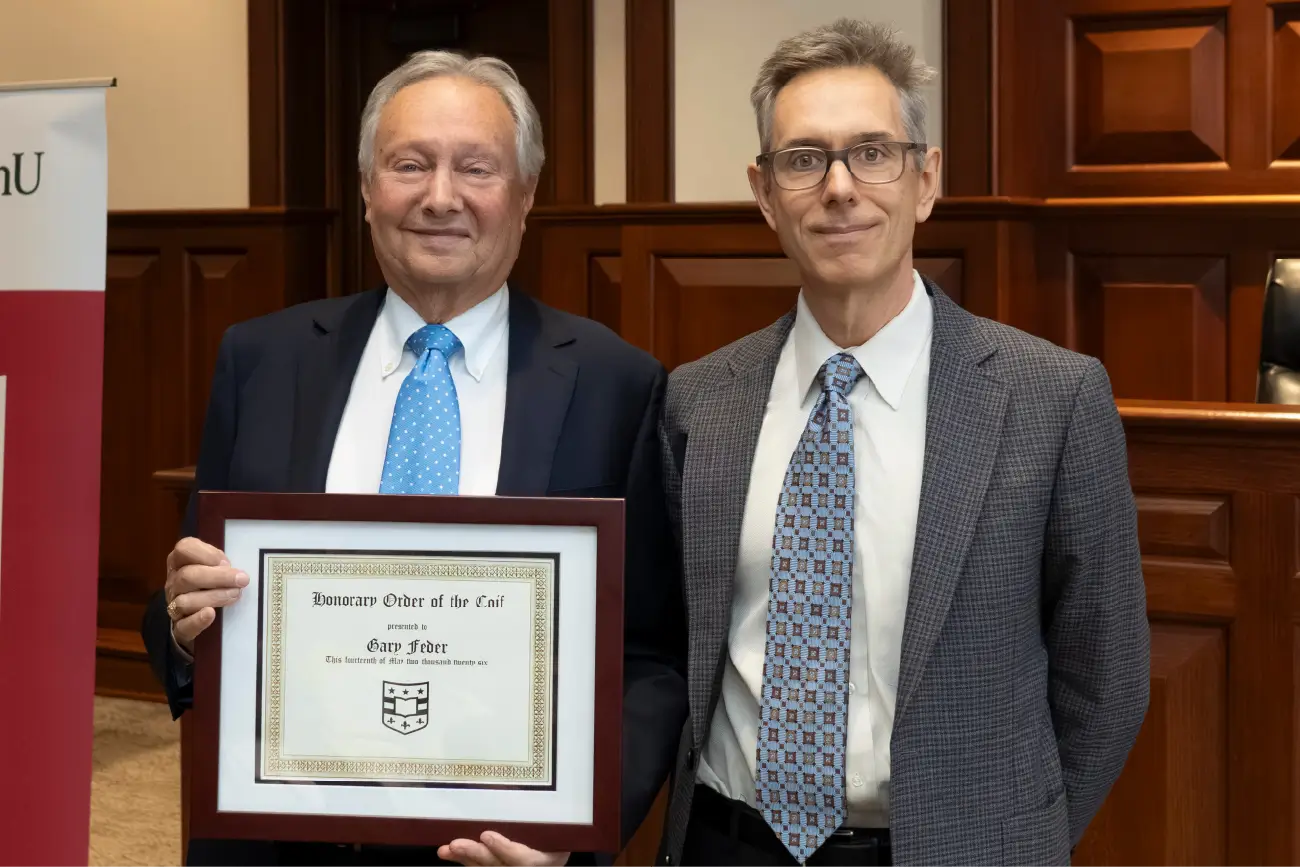
Dobie, who graduated Order of the Coif, is now a senior partner at Winston & Strawn in Chicago. He is widely recognized as one of the nation’s leading commercial litigators, securing victories in cases involving billions of dollars in judgments, landmark antitrust matters, cross-border and international disputes, and more than 100 class actions and multidistrict litigations. His recent work includes representing a Swiss company in an international arbitration in Washington, D.C., against the government of Italy and preparing for trial in a major antitrust case later this year. His practice spans industries including pharmaceuticals, energy, and technology and encompasses trial and appellate litigation as well as significant class action work.
Gliklad, a managing associate at Sidley Austin in New York, is building her own distinguished practice in commercial, class action, and antitrust litigation. Her work reflects the next generation of competition law, including cutting-edge algorithmic pricing class actions and other complex matters involving the financial services industry. As one client told The Legal 500 USA 2026, “Kristina Gliklad is an excellent junior attorney—poised, assertive, and super smart.” Before joining Sidley, she clerked for the Honorable John F. Kness of the U.S. District Court for the Northern District of Illinois and externed with the New York Attorney General’s Antitrust Bureau.
Parallel Lines, Different Directions
The resemblance between their paths is striking, but not complete. Dobie’s career reflects decades of leadership in major commercial disputes, antitrust matters, class actions, and cross-border litigation. Gliklad’s emerging practice reflects a profession increasingly shaped by technology, data, pricing algorithms, artificial intelligence, and public enforcement. One career shows the durability of traditional advocacy at the highest level, while the other shows its adaptation to new markets, new evidence, and new questions of competition.
Each has built a professional life extending beyond the courtroom. Dobie serves as U.S. Chairman of the Midwest U.S.–Japan Association, a public-private partnership that strengthens economic ties between ten Midwestern states, including Missouri, and Japan. In that role, he chairs the annual joint meetings in Tokyo and across Midwestern member states, bringing together US and Japanese governors, ambassadors, and senior business leaders to foster trade and investment. His work shows how legal training can serve not only litigation, but diplomacy, business, and civic leadership.
Gliklad brings a different set of skills. Fluent in English, Russian, and French, she has paired her legal work with writing, service, and international engagement. Her writing has earned recognition across disciplines, from winning the New York State Bar Association Antitrust Law Section’s student writing competition with an article on tying arrangements, written with thanks to Professors Drobak and Gerrit De Geest, to receiving a national bronze medal from the American Council of Teachers of Russian for an essay about her great-grandfather, Naym Gliklad, who served as a tank commander on the First Ukrainian Front during World War II. She remains active in professional and civic service as Chair of the ABA Antitrust Litigation Committee’s Young Lawyers Subcommittee and as a junior board member of the French American Aid for Children Association, a nonprofit she has supported for more than a decade.
Outside the office, Kristina’s longest-running passion is equestrian sport. A lifelong rider, she captained Columbia University’s equestrian team in college, rode with WashU’s equestrian team in law school, and still gets in the saddle on Saturday mornings. (And in an earlier chapter, she even appeared in an episode of Law & Order: SVU!)
The WashU Law Thread
For Dobie and Gliklad, the parallels are easy to spot. The more interesting point is what they did with them.
For WashU Law, that is the larger story. The school’s traditions endure not by producing one kind of lawyer, but by cultivating qualities that serve graduates wherever their careers take them.
A student editor can become a trial lawyer. A classroom lesson can shape a professional specialty. And a law school experience can become something that is both deeply personal and enduringly institutional—a family legacy that reflects the lasting impact of a legal education. Across generations, cities, firms, and legal eras, Dobie and Gliklad’s shared path illustrates the enduring influence of WashU Law and the ways its education continues to shape the legal profession.