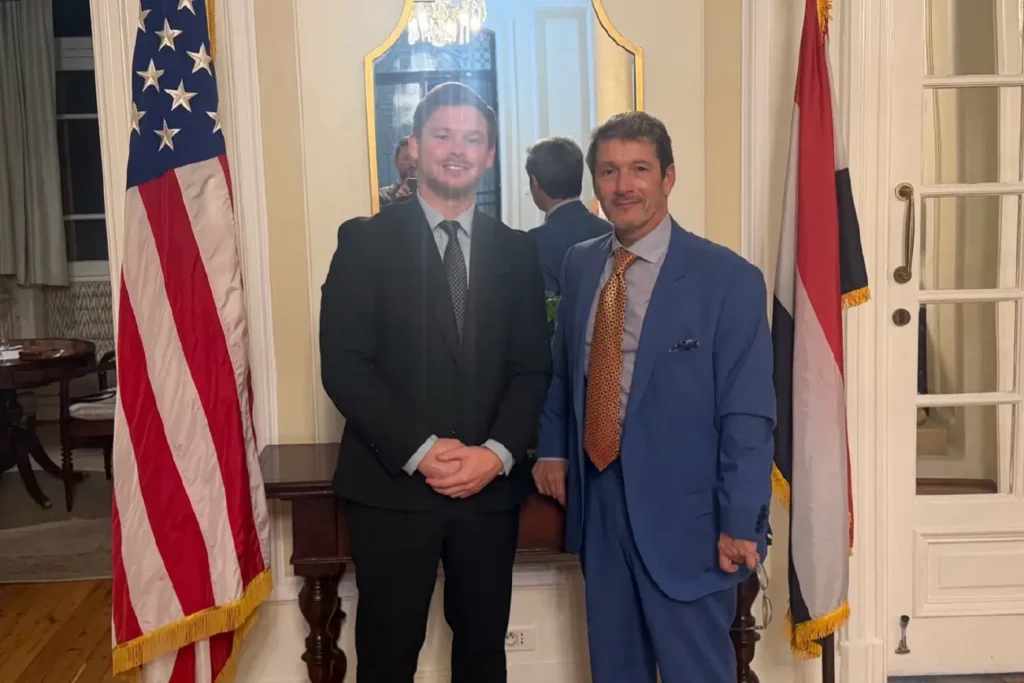
Oliver Roberts, Adjunct Professor of Law and Co-Director of the WashU Law AI Collaborative, recently traveled to Cairo, Egypt, at the invitation of the U.S. Department of State to discuss artificial intelligence regulation with Egyptian lawmakers and technology leaders.
On September 27, Roberts attended a dinner hosted at the residence of the Deputy Chief of Mission at the U.S. Embassy in Cairo. The gathering brought together leadership from Egypt’s Parliament and Senate, including lawmakers who introduced legislation addressing high-risk AI.
The discussions examined how governments can promote AI innovation while responding to emerging risks. Roberts emphasized the importance of avoiding overly burdensome regulatory requirements, highlighting concerns about the European Union’s AI Act, and discussed how existing legal frameworks can address AI-related risks and harms.
The conversations also examined competition between the United States and China in AI development. Roberts discussed the national security and financial risks countries should consider when relying on Chinese-developed open-source AI models, particularly when making long-term investments in public services and critical infrastructure.
Also in collaboration with the U.S. Department of State, Roberts participated in Techne Summit Cairo as part of Middle East Innovation Week. In a fireside chat titled “Who Regulates AI? Navigating Innovation, Power & Responsibility,” he discussed the roles of governments, technology companies, and courts in shaping AI governance. He also joined the panel “Data Sovereignty in AI: Balancing Innovation and Compliance,” examining questions of data control, security, and responsible technology adoption.
Roberts additionally delivered a workshop titled “When AI Gets It Wrong: Hallucinations, Ethics, and Responsible AI in High-Stakes Work.” The session explored practical risks in professional AI use, including inaccurate outputs, confidentiality, prompt injection, and the continued importance of verification and human oversight.
The visit builds on WashU Law’s global work with U.S. embassies to advance AI education and responsible adoption. In Morocco, Roberts led a roundtable with legal leaders at the U.S. Embassy in Rabat and delivered a briefing for Morocco’s Digital Development Agency. In Tanzania, WashU Law partnered with the U.S. Embassy in Dar es Salaam and Wickard on AI education programs for students, faculty, legal professionals, and community members.
The Egypt visit was coordinated with the U.S. Department of State and the U.S. Embassy in Cairo as part of these continuing international efforts.